Where the Road Ran Out
En route to Tosh, the landscape turned challenging.
That road had opinions about who should be on it. The path was prone to landslides, and a few medium-sized rocks had rolled down just moments before we passed. The place was remote. Only a handful of vehicles went by, most of them probably headed where we were.
I had no idea what the driver's approach would be. Would he speed up and cross the stretch quickly, or slow down and calculate every move? I wanted to ask him but also had enough common sense not to divert his focus at a crucial moment. On one side, rocks were ready to fall. On the other, a narrow rugged trail dropped into a deep valley. All of it together was only making my anxiety worse. I ended up saying something.
The driver engaged with the conversation and explained that it was simply how it was, and that people here are used to it. He added that driving this stretch in the dark is the most challenging part, and most people would not attempt that.
Drivers are the only familiar company in a new place, and they have the capacity to make or break the day. Ours was experienced and had a lot to share. We did not speak his language, but that was never a problem.
After a couple of kilometres, the roads got rougher, more like no road at all, and then we reached that point. A few cars were stopped in the middle of the road. I assumed it was traffic at first. Then I noticed cars lining up behind us and people stepping out with their bags. We got down to take a look and realised that was almost the end of the road. There was no motorable road beyond that point. On the other side was the entrance to Tosh village, accessible only on foot.
The final stretch of road had been completely damaged by a landslide. We had to cross it to enter the village. The site was scary; beyond the edge was just the valley. Homestay owners from Tosh were enthusiastically approaching tourists, convincing them to stay and offering to carry luggage up to their places.
The driver pulled us aside and explained that the car could not go beyond this point and that we were on our own from here. He said he would wait until we came back from exploring. I was not sure how I felt about that at the moment. Standing at the landslide site, I was reevaluating everything.
I had put Tosh on the list to experience a raw Himachal village. But secretly I was hoping for the season's first snowfall there. Tosh is at a higher elevation than Kasol, so the chances had seemed solid. That day, however, the sky was completely clear. If anything, it felt a little sunny, which only added to the disappointment.
I was still undecided about whether to go ahead or turn back and find alternate plans when the Tamil couple appeared. We took a moment to share our disappointments. Their driver had given them a couple of hours and wanted them back as soon as possible. After a brief pause, we decided to give it a try.
The road ahead looked like a tightrope walk. Literally one foot of space, and you had to stay focused not to slip. Priya and Vivek went ahead with their baby. Vivek carried the child, and we moved together through the difficult stretch.
Our driver, who I had assumed had disappeared long back, appeared out of nowhere while we were struggling through it. That is the thing about mountain people. He came over, lent a hand at the difficult parts and at one point carried the child himself. We crossed safely because of him. He assured us again that he would be waiting and left us to it. Priya was more touched by the driver's act.
We crossed an iron bridge and technically stepped into the village. The land was uneven, sloping in all directions, with shops and houses built according to the geography. We climbed slowly and passed a few travellers coming from the opposite direction. Since it was already past eleven, our eyes were automatically looking for cafés. I had a list prepared from research but was ready to walk into anything that looked interesting.
Along the way we had a nice little talk with Priya and Vivek, the usual questions about education, work, where we were based. Typical Tamil people conversation, with the insider jokes that come naturally once you establish the basics. Within a short while, the little girl had grown considerably more talkative and was attaching herself to me. I was still surprised she was walking the whole way without complaint.
We passed a school. It was a working day, and it looked like a lunch break was underway, students running along the veranda. We stopped and waved at a few of them. They waved back, cluelessly, not knowing what we were about. A fully functioning school in a remote Himachal village. It made me genuinely happy. I wanted to go in and spend some time there, but that would have been a strange thing to do without reason. We moved on.
Some cafés were empty, some had a few people. All small, each with its own character. We noticed people carrying wood, others passing with loads of vegetables. Everything here is carried by people. Men and women both, going about the everyday business of keeping a village running.
We stopped near a group of women who were spinning yarn and asked about the chances of snowfall that day. The woman we spoke to, somewhere in her forties, looked distinctly unenthusiastic about winter. Her expression said everything, and the few words she offered in a language we did not know confirmed it well enough.
We continued walking without pushing the conversation further, half-joking among ourselves that things might get difficult up here. But we understood the truth of it. Harsh winters and heavy snowfall are not romantic to the people who live here. It is magical only to people like us, arriving from distant places, from hot summers, with the luxury of finding it beautiful precisely because we do not have to survive it.
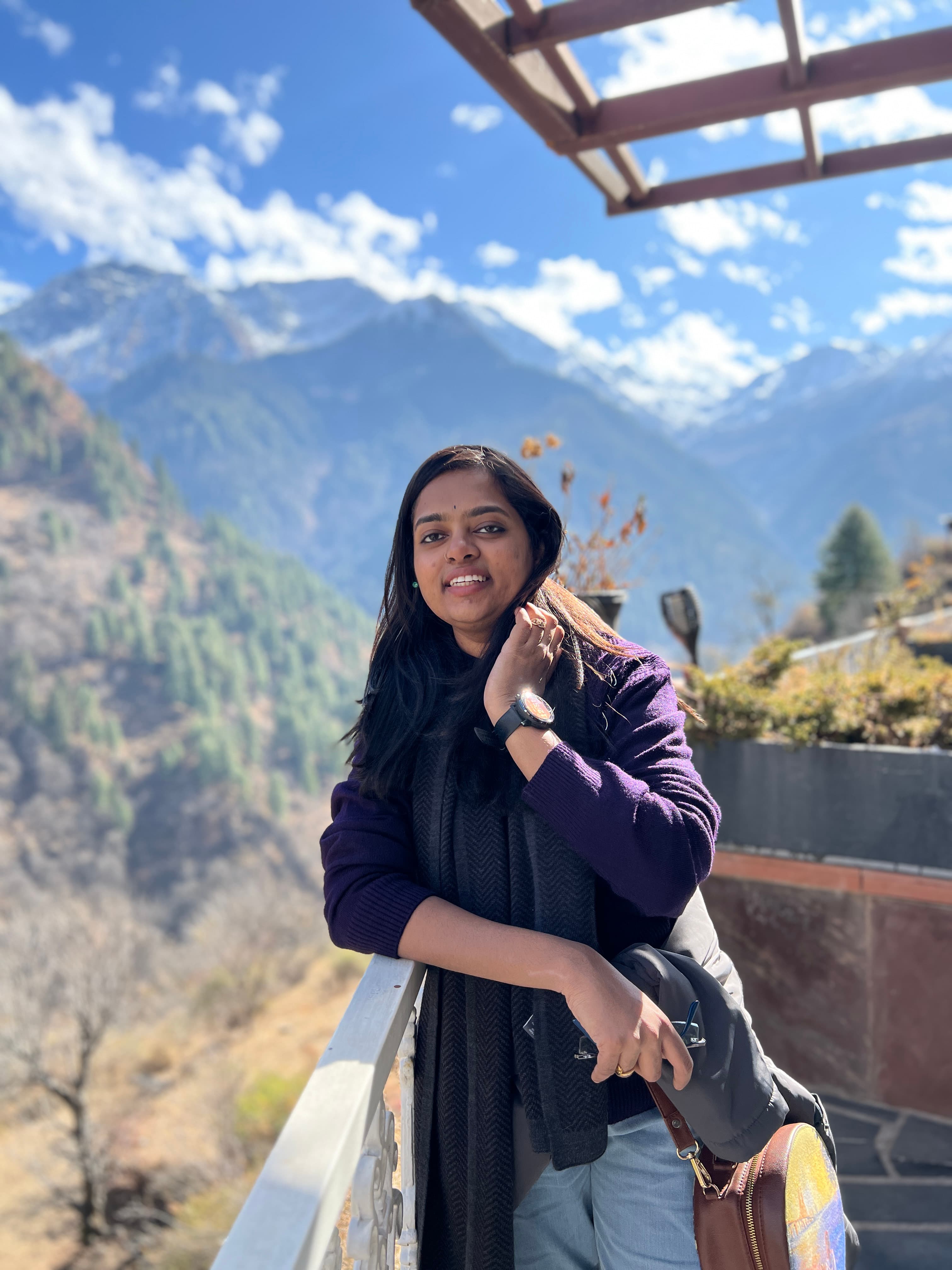
We found a viewpoint with mountain views and the view of Barshaini dam and rested there for a while to get some good pictures and to soak in the view. The kid by then was turning cranky and was refusing to cooperate, so the father had to carry her. As the climb was getting tougher, we decided to reach a café and settle down for a bit.
Pinki Didi's café. The name sounded very random to me. But it had great views. Not just regular mountains, but entirely untouched peaks, surrounding us on all sides. I had wanted to see the snow there. That day the sky was clear and it felt like nature's way of mocking. The weather did a small favour though. The temperature dropped bit by bit as we stood there. The mountain breeze picked up. The peaks had patches of old snow on them. The app said it was minus four degrees, currently snowing. We were wondering where exactly that observation was being recorded, probably somewhere on the peaks visible to us.
The café was more of a viewpoint. A semi-open space with umbrellas and a kitchen attached, the food being an excuse to sit there longer. We ordered and shared. The couple's driver had been particular about getting them back early. We had our own time, but it was close to three in the evening and the descent was not going to get easier without light, so we packed up to get down.
The kid somehow realised that we were going to leave the place in two separate cars and wanted me to join her. She started pressuring her mom in her baby voice, "let's take aunt with us." I did not engage with the kid's plea as I didn't want to spend my travel days with a toddler, as I was in my child-free phase for a reason. We somehow convinced her that I would meet her back at the hotel.
Back at the landslide site, we had to cross that stretch again. The driver was there right when we got there. I was relieved to see him there again. This time, the couple's driver also came in to help, and we got back to our cars safely and headed back to Kasol.
Tosh did not give me the snow. But it made me spend time with a little girl who wanted to take me home with her. Not a bad trade.
1 / 2
Stay with the journey
New chapters and stories, delivered to your inbox when they are ready. No noise — only words worth reading.